How do we raise children who thrive?
Marc Schwyn, co-founder of Bamboo Valley. First given as a talk to our parents, May 2026.
Hi everyone, thank you all so much for coming. We are here today to talk about one of the most important questions of our lives: how do we raise our children so they will be happy, successful, healthy, and have lots of great relationships? Across all cultures and socio-economic groups, we all agree that these are the things that matter most.
Here's the tragic thing. Even though we all want the best for our children, it feels like there's no way of knowing how to actually do that. Parenting didn't come with a manual. Some of us try sending them to the best schools and getting the best grades. Others prioritise letting children be children.
But we all agree: if there was a button you could press to guarantee your children's success, happiness, and great relationships, we would all press that button.
The problem is that button doesn't exist. We don't know what qualities drive these outcomes. Especially now, with AI and automation approaching, people wonder more than ever: what is the best education for their children?
As a highly engaged parent, and founder of Bamboo Valley, an alternative outdoor nature school, I've been facing these questions every day. And I've made it my life's purpose to find the answers. Since the birth of my first child, I've spent at least three to five hours with my children every single day. Observed them deeply. Looked for ways to support them as naturally as I can, to develop not just their future success, but their happiness, health, and great relationships as well.
We built Bamboo Valley as a result of that passion: a place where we develop the whole child, not just their academic abilities. And in the last year, with AI making enormous advances, I've used it to dive into an enormous body of information to find the answer to this question. I've scanned hundreds of books and thousands of studies to find the best parenting strategies for any obstacle our children may face. I've scanned for patterns and profiling techniques that could help me understand and connect with my children on a deeper level, so I could unlock their greatest potential and human capabilities.
But all my activities, as a parent, as a school founder, as a researcher, kept bringing me to the same fundamental questions:
- What education do children need to thrive?
- Do they get that education in schools?
- How do I make sure that my child gets that education?
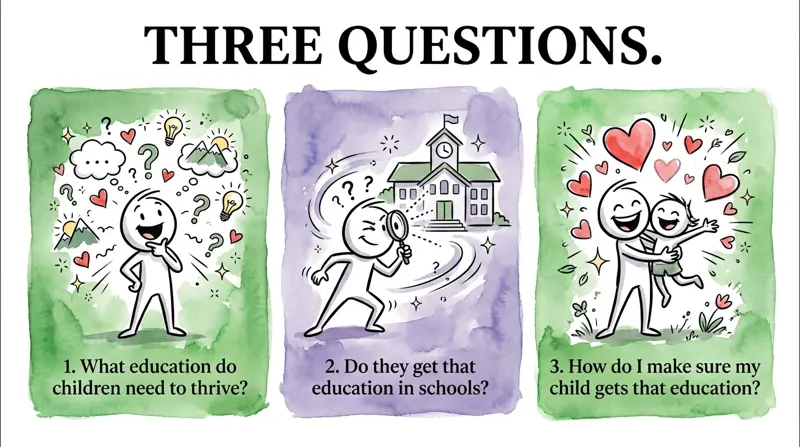
My research led me to a series of unbelievable insights. So let's look at them.
1. What education do children need for a successful and happy life?
It turns out that there is a massive body of research on this topic. And it nearly unanimously points to exactly the same twelve qualities.
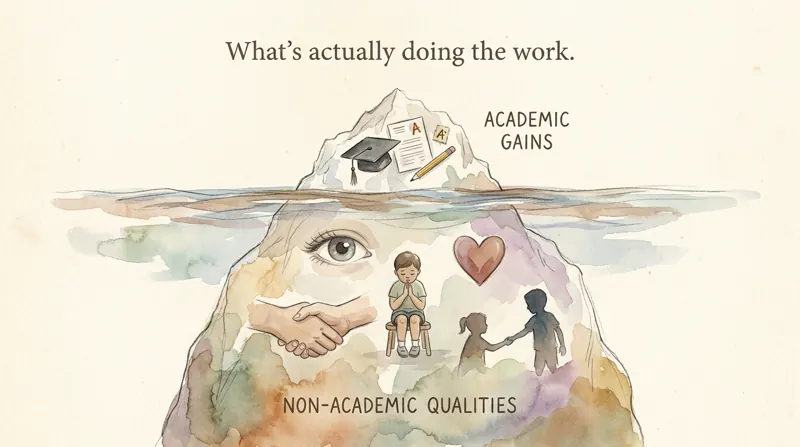
James Heckman is a Nobel-laureate economist who ran one of the most famous studies on this question. They took a group of poor children, gave half of them two years of really high-quality preschool, and gave the other half nothing. Then they followed them for forty years. The early academic gains, the IQ boost, faded by third grade. So you'd think the program failed. But forty years on, the preschool children were doing way better. More graduations. Better jobs. Higher incomes. Fewer arrests. And when Heckman dug in, he found that up to two-thirds of that benefit had nothing to do with anything academic. It came from things like curiosity, self-control, persistence, and the ability to get along with people. The qualities a thriving life is actually built on.
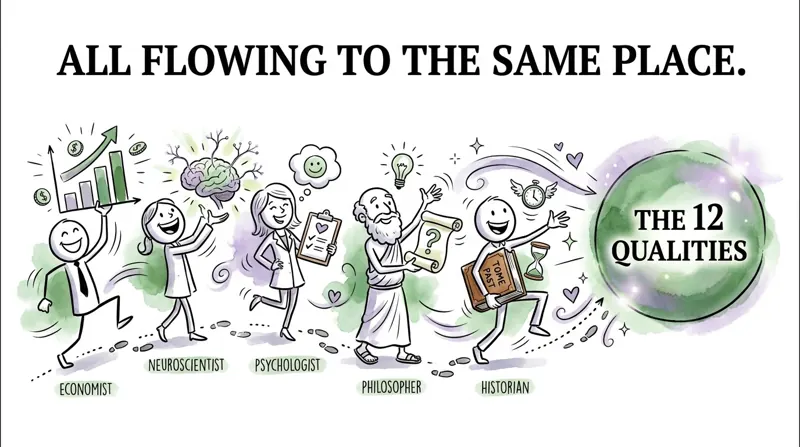
And Heckman isn't alone. Books written by economists, psychologists, neuroscientists, historians, and journalists, using radically different methods. Randomized trials. Eighty-year studies. Brain scans. Even a 2,500-year cross-cultural survey of moral writing across Confucianism, Buddhism, the Abrahamic traditions, and Greek philosophy. All keep arriving at the same twelve qualities:
- Knowing yourself: what you feel, what you want, what you're good at
- Steering yourself: managing impulses, finishing what you start, holding attention
- Sticking with it: keeping going when something is hard, slow, or boring
- Getting back up: recovering from failure, disappointment, fear
- Reading the room: sensing what others feel, want and mean, even when unsaid
- Speaking up for yourself: saying what you need, holding ground, not folding under pressure
- Spotting harm: noticing when a person, situation, or message is unsafe
- Working with others: sharing, cooperating, leading without bossing, fitting in a team
- Making and keeping friends: closeness, loyalty, repair after a fight
- Solving problems: sizing up a situation, generating options, picking and acting
- Thinking creatively: making something new, breaking a stuck pattern
- Staying curious: asking, wondering, wanting to know how things work
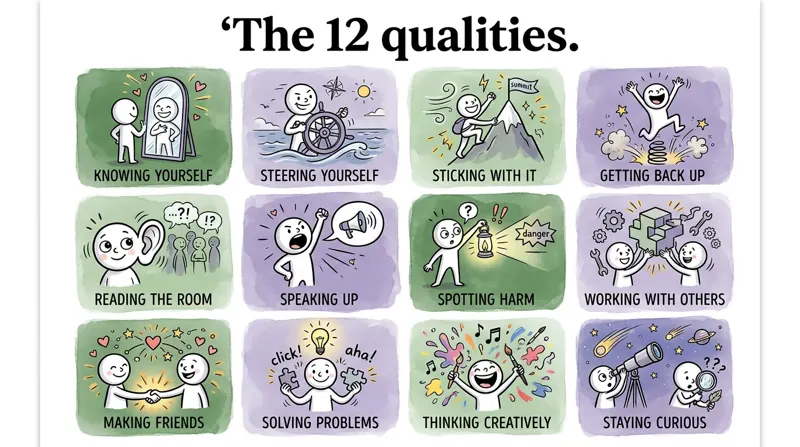
And today, all the major institutions that study this, the OECD, the WHO, Harvard's Center on the Developing Child, CASEL and the World Economic Forum, have all arrived at this same short list.
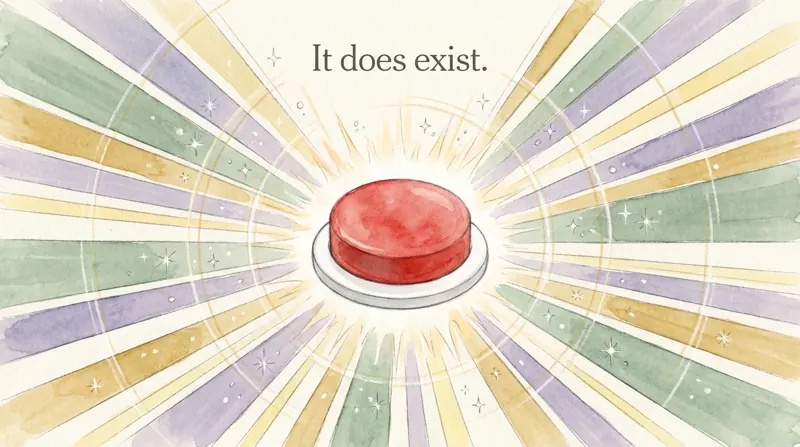
There isn't a single item on this list that any parent in this room would argue with. Deep down, we've always known these are what matter. And here's what's striking: this list is as close as anyone has come to the button we wanted at the start. The one we thought didn't exist. It does exist. We just hadn't pieced it together until now.
2. Is school important for life success?
Yes, up to a certain point.
Completing high school and college gives you a very big income and happiness boost. Bachelor's degree holders earn $1.2 million more over a career than high-school graduates, and they live 8.5 years longer. That's the floor every parent in this room wants their child to clear.
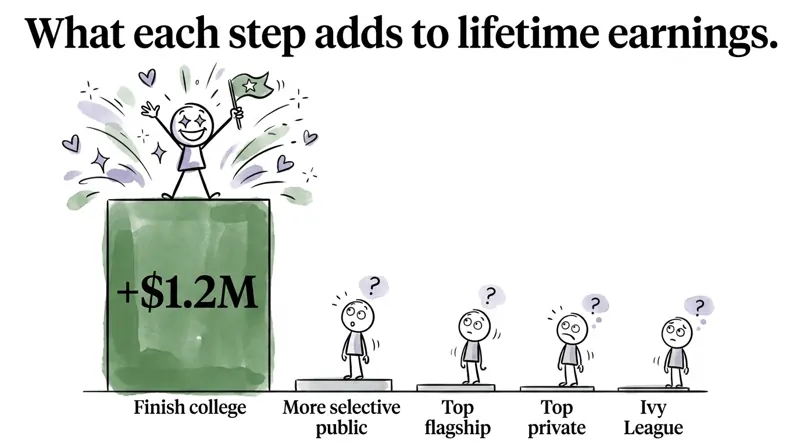
But beyond completing an average college, the marginal benefit is minimal, all the way up to and including the Ivy League. A more selective school over a less selective one: a small premium that fades within a few years. An Ivy League school over a state flagship, for the average child: zero additional earnings.
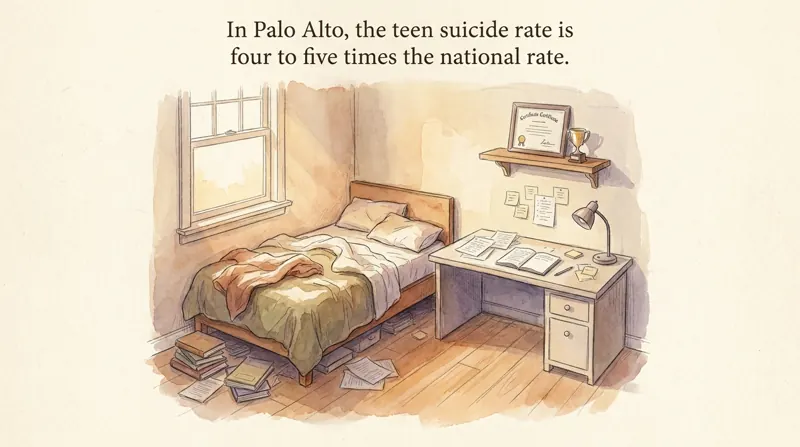
Yes, the Ivy does give your child a higher chance at reaching the top 1%. But it comes at a massive cost. At Yale Law School, 70% of students report mental-health challenges during their time there. A third have seriously considered suicide. Forty percent diagnosed with anxiety. A third with depression. In Palo Alto, California, where 60% of children go to elite colleges, the teen suicide rate is four to five times the national rate. The children the system is working for are the ones breaking under it.
So while school and grades have very little marginal benefit beyond completing an average college, developing the qualities, the life skills, has a massive impact.
Money isn't where happiness comes from. Fifty years of research keeps pointing to the same picture: about half of how happy you are is genetic: temperament. About ten percent is your circumstances: where you live, what you earn, the size of your house. The remaining forty percent is what researchers call intentional activities: habits, mindset, relationships, what you do with your attention.
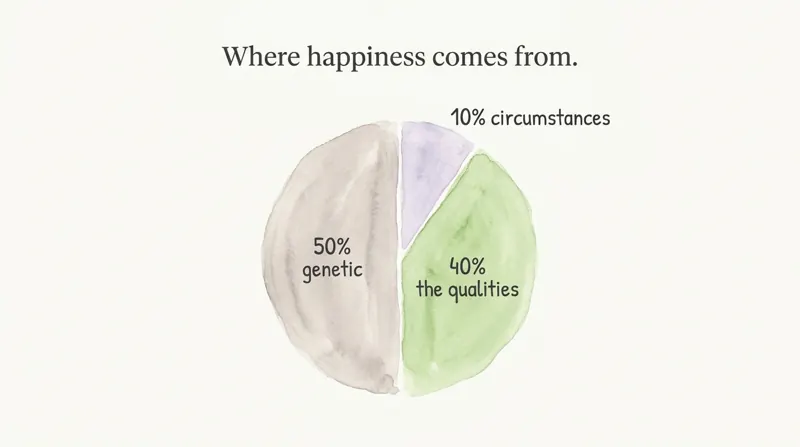
Money sits inside that ten-percent slice. And above $100,000 a year, more income barely moves the needle for most people. So the whole output of the academic path can buy you, at most, a small fraction of one slice. The other forty percent, the big uncapped slice, is the qualities.
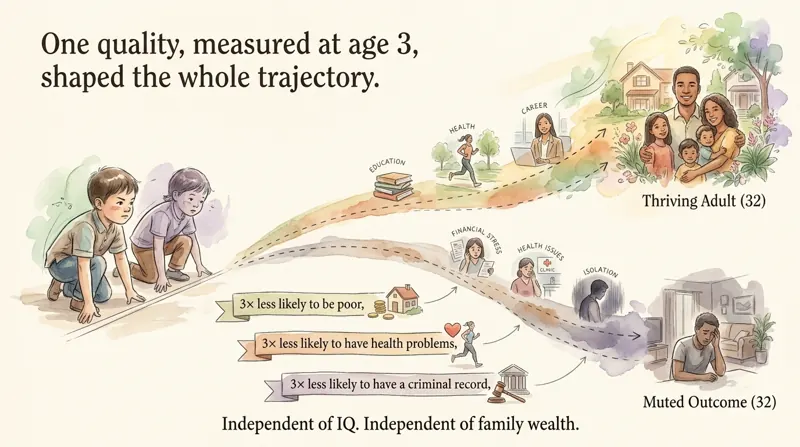
But these qualities don't only produce happiness. They produce income too, and health, and longer life. The Dunedin Study tracked 1,037 children in New Zealand from birth to age 32. They measured one thing in early childhood: self-control. By age 32, the children who'd scored highest on self-control were thriving: earning more, healthier, with more stable lives. Compared to their lowest-scoring peers, they were three times less likely to end up in poverty. Three times less likely to have serious health problems. Three times less likely to have any criminal record. Independent of IQ. Independent of family wealth. One quality, measured at age three, shaped the whole trajectory.
Or take conscientiousness, the broader umbrella: the kind of child who reliably follows through, finishes what they start, and does what they say. The cleanest economic study finds that being noticeably more conscientious than average earns you around $567,000 more over a lifetime. That's roughly half the entire bachelor's-degree premium, from a single personality trait.
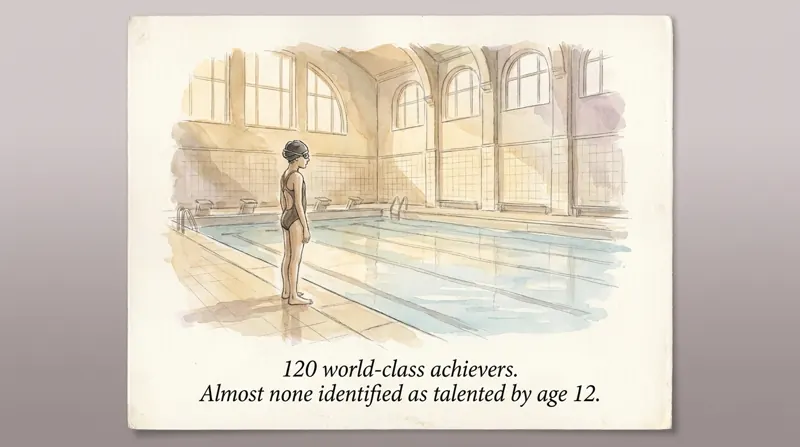
And this isn't just the average child. The exceptional ones, too. A researcher named Benjamin Bloom interviewed 120 world-class achievers: twenty-one concert pianists, twenty-one Olympic swimmers, twenty mathematicians, twenty-one sculptors, twenty-one research neurologists, eighteen tennis players. The actual top of their fields. He interviewed them, their parents, and their early teachers.
Almost none of them had been identified as talented by age twelve. Their parents consistently picked a different sibling as the more naturally gifted one. They didn't go to elite schools. What they had was a thing they became obsessed with, the willingness to spend ten thousand hours alone with it, a family who didn't get in the way, and a teacher somewhere who took them seriously. Curiosity. Persistence. The capacity to stay with one thing for years. These produced the top of every field Bloom studied.
And finally, developing the qualities is not a trade-off with school. They don't compete with academic achievement. They produce it. Self-discipline at age twelve predicts adult academic performance more than twice as strongly as IQ does. Develop the qualities, and the academic outcomes follow as a side effect.
So the choice isn't "qualities or school." It's: invest in the qualities, and your child gets a wildly better life: happier, healthier, richer, longer. And the academic outcomes come along, with or without the elite school.
3. How do we make sure that our children are getting that education?
That leaves us with the final question, and the one both me and my wife have dedicated our lives to. How do we actually make sure our children are getting that education?
Luckily, the answer is much more humane than you would imagine. You don't have to get your child into an exclusive school you cannot afford. You don't have to take your child out of school entirely and radically change your lifestyle. All it takes is a mindset shift on what is important, and a few simple tools to help guide you along the way.
The mindset shift is simple, because it confirms what most of us have felt all along. Yes, school is important. But which school and which grades aren't. The time spent chasing the best grades is much better spent developing the character traits proven to lead to better life outcomes.
Marc